

By Sarah Burchard
12 December, 2005
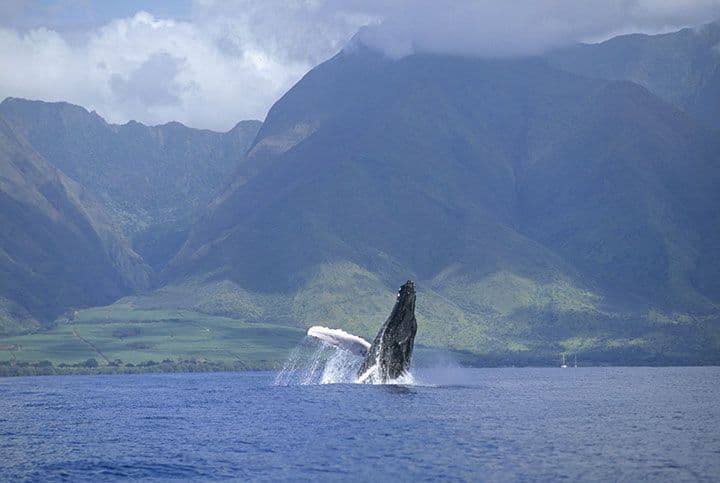
Photo courtesy of Hawaii Tourism Authority (HTA) / Tor Johnson.
But out of all those pictures, only a hundred or so are what he would consider “blow-up worthy.”
“What you have is 40 tons of whale coming out of the water with no warning at 20 to 25 miles per hour,” Kaufman said. “That’s 80,000 pounds of flesh falling. That’s not easy to catch.”
Now if a skilled photographer with 30 years of experience studying whales only gets one keeper in a hundred, what chance does does an amateur have? A better one with these Kaufman tips:
A 35mm single-lens reflex camera is ideal for ease and flexibility, but any sort of camera will do.
Use an 80 to 200mm zoom lens. (Kaufman uses a 300mm fixed lens for his photos).
If you have an autofocus camera, set it to the “sport” or “action” mode. If not, set the shutter speed for 1/500th of a second to minimize the effects of movement. Set the ISO for 200 or more.
For film, go with ISO 100 or faster (ISO 200, ISO 400, etc.).
Meter the ocean, not the sky.
Steady your focus on the horizon.
Hold the camera in place; don’t follow the movement of the whale.
If you’re shooting digital video, avoid the temptation to zoom in and out.
Join our newsletter for travel inspiration, insider tips and the latest island stories.
By subscribing, you agree to receive emails from Hawaii.com. You can unsubscribe anytime. See our Privacy Policy.