

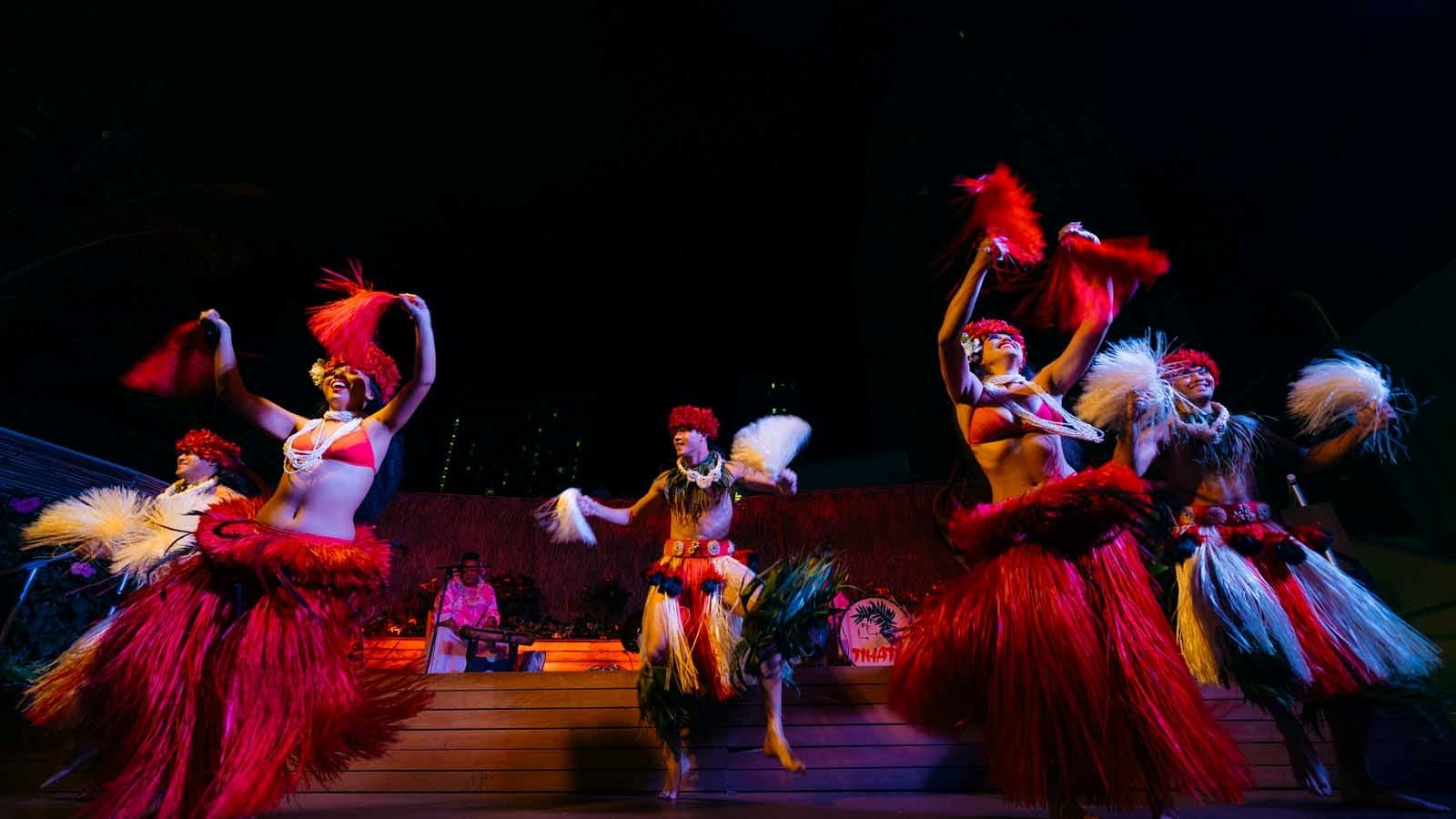
Inside the Hawaiʻi Kuauli Pacific & Asia Cultural Festival: Three Days of Culture, Fire and Food in Kona

Held every June at Courtyard by Marriott King Kamehameha's Kona Beach Hotel, the 3-day festival celebrates traditional dance, music, food and fashion from Asia and the Pacific Islands.
On the first night of the Hawaiʻi Kuauli Pacific & Asia Cultural Festival, the MC asks everyone to take their seat and refrain from talking. From the stage a man dressed in a crisp white collared shirt, draped in a white and pink kīhei — a traditional Hawaiian wrap tied over the left shoulder — blows into his pū (conch shell), its low, resonant call filling the silence. The kumu, or master teacher, begins to chant in the style of leo kiʻekiʻe — a Hawaiian falsetto with continuous breaks and strong vibrato. The protocol then moves into drums, hula and more chanting, performed in rounds, overlapping so that the sound is nearly continuous. The kumu chants to a golden lei, raising it in praise before placing it around her neck. Behind her, the hula dancers create a low, steady hum, tapping Kāʻekeʻeke — thick bamboo poles — against the floor in rhythm. Then, gradually, they begin to sing together, like a choir, the dancer at the center holding an ukulele.This is Hōʻike — a traditional presentation and cultural exchange — and it kicks off the annual Hawaiʻi Kuauli Pacific & Asia Cultural Festival on Hawaiʻi Island.
Ranked No. 7 on USA Today's 10 Best cultural festivals in the country, The Hawaiʻi Kuauli Pacific & Asia Cultural Festival is held every June at Courtyard by Marriott King Kamehameha's Kona Beach Hotel, organized by Hawaiʻi Pacific & Asia Cultural Celebrations (HIPACC). Over three days, there are four main events celebrating traditional dance, music, food and fashion, with ongoing language workshops and vendors selling art and traditional crafts to engage with in between. The festival is livestreamed at hikuauli.com for those who cannot attend in person.

HIPACC is an umbrella organization for various Hawaiʻi Island festivals. Its mission is vast: to build community through cultural principles, to restore understanding of indigenous practices and to celebrate — without hierarchy — the Pacific and Asian cultures that make the island what it is.
Hawaiʻi Kuauli, or Hawaiʻi Nui Kuauli, is one of the traditional names for the island of Hawaiʻi, honoring Chief Hawaiʻi Nui Kuauli — a legendary leader known for his deep connection to the land and visionary approach to sustainable living. Under his guidance, the island and its people thrived, living in balance and abundance. The festival carries that legacy into a three-day celebration of cultures that have found a home in Hawaiʻi.
Night One: The Hōʻike

As I described above, the festival opens with a protocol called Hōʻike. Hawaiʻi is the host nation for the event, and after the opening Hawaiian performance, each visiting nation makes its presentation in turn. The exchanges are conducted almost entirely in native languages — there is very little English, except occasionally from the MC.
Samoa presented its gifts in a traditional ceremony of the highest order — a formal protocol reserved for royalty — bringing food wrapped in ti leaves, a large lau hala mat, a hat and lei. Hawaiʻi returned gifts to each nation after each presentation. China followed, then Tahiti, then Aotearoa. More hula followed. One kumu who presented that evening has been teaching for 49 years. The hālau (hula school) was filled with female kūpuna, or elders, dressed in red velvet dresses and Niʻihau shell lei that looked like strings of pearls.
Day Two: Fashion and Fire

The second day opens with the excitement of rapid-fire Tahitian drums and hula. The energy in the room shifts into party-mode. The fashion show portion of the event is one of the most popular. Designers from across the Pacific and Asia present collections that riff on traditional island dress, cultural art and contemporary streetwear — all of it rooted in identity rather than trend. The House of Kamamalu dressed one of its models directly on stage, the garment coming together in real time in front of the audience. Funk N Soul97, an extraordinary beachwear label from Samoan-Australian designer Tia Semi, is extra impressive when you find out she has done all of this while living with deafness, cerebral palsy, intellectual disability and epilepsy. Missing Polynesia, based on Oʻahu, pulls from cultural art to build its visual language. Kua, by Hawaiian designer Makua Camarao, creates streetwear that functions as cultural storytelling. Dezigns by Kamohoaliʻi, a renowned kumu from Hawaiʻi Island, makes garments designed specifically to educate. Laitahikoa Designs closed the show by performing a SZA song as their collection walked the runway.

Running throughout all three days of the festival is a marketplace where vendors set up alongside the main events. The fashion designers showing in the runway show have booths where you can purchase their pieces after watching them walk. Local jewelry makers, artists and other Hawaiʻi Island brands fill out the rest. It’s an extension of the cultural experience as a whole.

That evening brought the fireknife competition — Le Kaua Ailao — which drew two divisions: Vaitaimi (ages 17 and under) and Matua (18 and older). The judges are fireknife champions and teachers themselves, and they score on three criteria: speed, costume and what can only be described as warrior presence — the ability to project power, aggression and ferocity. The combination of spinning fire, rhythmic precision and sheer physical intensity makes for an exciting competition.
Day Three: Taste of Pacific and Asia

The final day belongs to the chefs. The Taste of Pacific and Asia is a culinary event featuring tasting stations from Hawaiʻi Island restaurants and two live competitions: the Hoʻohuihui Cocktail Showdown for mixologists and the Chef's Challenge for the kitchen. There are three competing chefs, which you can watch cook, and three competing mixologists who mix their drinks on stage. Everything is filmed live and shown on a big screen, so even if you are in a different room you won't miss any of the action. While the competitions are happening, guests roam the room feasting on dishes prepared by 17 more visiting chefs. The food and cocktails were all excellent. The experience is comparable to a Hawaiʻi Food & Wine Festival event — graze and sip style.


The Hawaiʻi Kuauli Pacific & Asia Cultural Festival is not a tourist event that happens to include cultural content. It is a cultural event that welcomes tourists. Almost nothing is translated into English for your convenience. The protocols are observed in full. The visiting nations are treated as nations. Everyone goes home knowing something they did not know before.
It is held annually at Courtyard by Marriott King Kamehameha's Kona Beach Hotel in Kailua-Kona over Kamehameha Day weekend in June. For tickets and information about the festival, visit hikuauli.com. To book a hotel room click here.

Editor · Oʻahu
Sarah Burchard has called Oʻahu home since 2017. com, Hana Hou, FLUX Hawaiʻi, Forbes, Hawaiʻi Magazine and Honolulu Magazine.
More from Sarah →